

When did you receive your docentship at the University of Turku and where are you working now?
I received my docentship in the Cultural History of Ancient Persia in April 2024. I am currently a University Researcher at the University of Helsinki, and will start as Professor in Ancient Near Eastern history and culture in January.

What have you been researching and why?
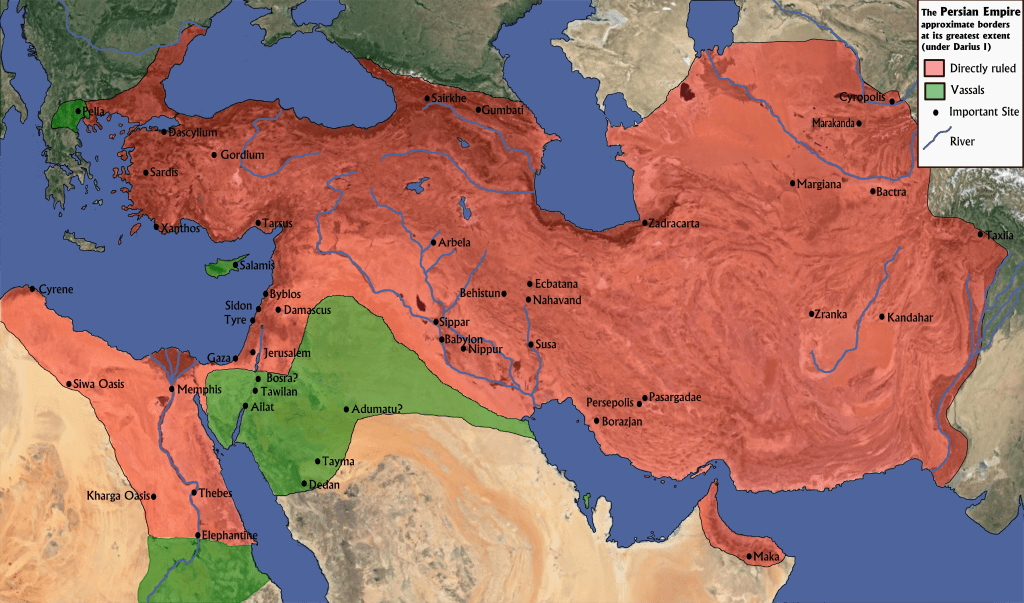
In my doctoral research I explored the heavily debated issue of Persian influence on Jewish apocalyptic literature from the turn of the eras (c. 200 BCE-200 CE). Since a number of big ideas can be found in both Jewish and early Christian apocalypses and in Zoroastrian texts, historians and theologians have long suspected a cultural dependency of some kind. Using tools from the sociology of religion I argued that a close look at the historical context of the Achaemenid Persian Empire (c 550- 330 BCE) was necessary for an understanding of the relevant social and cultural phenomena.
My work since then has looked more closely at a variety of specific cultural issues, all with reference to social contexts of the Persian Empire. For example, I have looked at how understandings of Judean kingship were impacted by Persian kingship, how mythologies of creation related to Persian royal ideologies, and the ways local elites dealt with regime change. I have also been interested in issues of orality and literacy, and how understanding various types of media are important for how we reconstruct evolutions in culture in ancient history. The latter has also involved an interest in the ways the Ancient Near East has been portrayed in modern media, in particular film.
What are you researching now?
I am currently in the early stages of my ERC Advanced Grant “Work without End: Informal Taxation and Forced Labor within Persian Southern Levantine Temple Economy and Society.” This project investigates, among other things, how ancient cultural understandings of labor shaped the structure of ancient economies, primarily in relation to ancient temples and the issues of forced labor and informal taxation (social structures enabling state demands). It also asks how modern assumptions have impacted and hampered our understanding of the ancient economy.
What current debates does your research relate to?
My current research deals with fundamental assumptions concerning ancient societies, particularly with one question at the core of many contemporary debates: do economies determine society, or does society determine the economy? How much do cultural assumptions shape the tasks (labor) deemed possible and desirable? Are modern human systems (culture, society, economy) fundamentally different from ancient, pre-industrial ones?
What led you to cultural history in the first place?
My career path has been atypical, moving from Communications and Film Studies to the exploration of Judaeans and their literature in the Persian Empire, though an interest in human communication with a historical and sociological bent has permeated all my research. If we want to understand how humans communicate, we need to understand the cultures that give it its meanings as well as how it has changed through time.
What does the docentship in cultural history at the University of Turku mean to you?
The study of the Ancient Near East has a long tradition in Finland, but it has largely been based only in Helsinki. I hope with this docentship I will be able to help expose Turku historians and students to the field, and expand the contributions of Finland to its study.
 Kulttuurihistorian seura